-
MarTech Services

-
Solutions
Omnichannel Orchestration
Make sense of your data. Data meets innovation to create unparalleled customer experiences and drive your business forward.
Email Deliverability
Email campaigns with unmatched inbox placement, real-time insights, and expert support with our Email Deliverability solutions.
Organic Search Amplification
Organic Search Amplification puts your brand into Google and Bing autocomplete - turning that generic search into a branded one
-
Website Services
Website Development
We bring together expertise, creativity, and measurable results, making us the go-to choice for HubSpot website creation.
Website Migration
Our approach to website migration goes beyond a technical transfer; we prioritize a user-centric experience.
Website Maintenance
Optimize your online presence with effective, growth-driven websites focusing on nurturing website visitors, creating and deploying content, and tracking progress with precision.
Website Audit
Is your website performing at its peak? Our CMS Consultants are here to help you find out with our comprehensive Website Audit service.
- Case Studies
- Blog
-
Company
Clients
We have worked with clients from various industries across the globe, making our journey diverse and exciting.
Team
We put decades of experience where our mouth is. So what you get is market-tested and tried, not theory. We believe in plain speak, which we believe works better than jargon.
Solutions Partner
BlueOshan is not just a partner; we are among the most experienced and adept in the HubSpot ecosystem.
- Contact Us


Christina Rachel Rajiv
March 20, 2026

For many SaaS founders and CMOs, the challenge is no longer just generating leads. The bigger problem is managing the data those leads create. As companies expand into global markets, their tech stack grows quickly: CRM, billing systems, product analytics, and marketing automation tools. Over time, these systems start operating in silos, making it harder to get a clear view of customers and performance.
Many high-growth companies are starting to address this by focusing on data unification instead of adding more automation. Bringing data from different systems into one place makes it easier to understand customers, measure marketing impact, and make better decisions. This is why building a unified marketing data layer through HubSpot’s Data Hub, is becoming increasingly important for scaling SaaS teams.
The Era of Marketing Automation Alone Is Over
In the early days of the Indian SaaS ecosystem, marketing automation gave companies a clear advantage. Automating email campaigns or LinkedIn ads was enough to stay ahead of competitors.
But as companies grow, this approach starts to break down. Automation tools operate in isolation, and the data they generate lives in different systems. Over time, this creates operational friction and slows teams down.
The Problem of Having Too Many Tools
The average Series B SaaS company now uses more than 40 different tools across their go-to-market teams. When these tools do not share information, you get disconnected data. Marketing views a person as a quality lead, Sales views them as a contact to be reused, and Finance views them as a risk to revenue. This happens even if every department is looking at the same person.
Automation Without Intelligence
Without a shared data layer, automation is just repetitive communication. Sending an automated request for a demo to a user who just submitted a high priority support ticket is not efficient and it harms the reputation of the company. To solve this, many firms are seeking a specialized HubSpot Partner in India to move beyond basic sequences and into complex data organization.
The Strategic Shift to Data Unification
Data unification is the process of combining data from different sources to create one consistent view of the customer journey. In SaaS terms, this means connecting your product usage data with your sales efforts.
Accurate and Shared Information
When your CRM, product usage data, and billing information are connected, you reach a state where all departments use the same information. This allows for:
- Predictive Revenue Forecasting: Moving from estimates to projections based on facts.
- Lifecycle Marketing: Sending messages based on how a user actually interacts with the software, not just email clicks.
- AI Readiness: Artificial intelligence is only as useful as the data it uses. A unified data layer is a requirement for any real AI project.

What HubSpot’s Data Hub Enables
HubSpot has evolved into a powerful Data Hub through Operations Hub and enhanced data modeling. This allows Indian SaaS companies to use their CRM as an active management system rather than a static database.
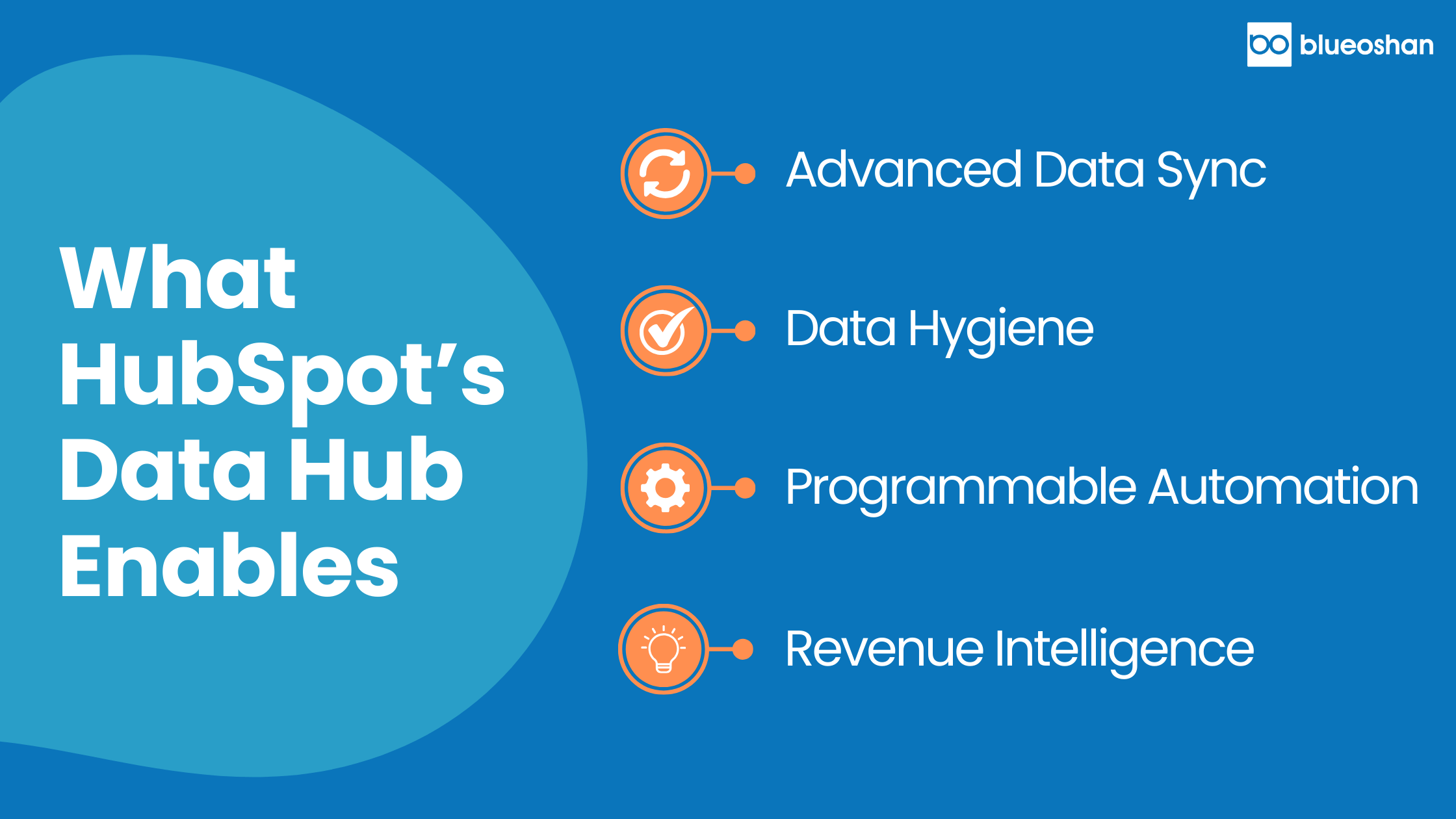
- Advanced Data Sync: Real-time synchronization between HubSpot and systems such as Snowflake, NetSuite, or Jira.
- Data Hygiene: Automated cleaning reduces duplicate records and outdated contacts.
- Programmable Automation: Workflows can include custom logic for advanced lead scoring, territory management, or operational workflows.
- Revenue Intelligence: Teams can track which campaigns or content eventually lead to revenue, even months later.
Why Indian SaaS Companies Are Prioritizing This Now
The shift toward Data Hub implementation is based on three main factors specific to the Indian market:
1. Efficiency Over Growth at Any Cost Investors increasingly look at metrics like customer acquisition cost and lifetime value. Improving these metrics requires accurate and connected data.
2. Global Expansion Complexity Many Indian SaaS companies now operate in multiple regions, including the United States, Europe and Southeast Asia. Managing currencies, languages, and compliance requirements like GDPR or DPDP becomes easier with centralized data systems.
3. Enterprise Sales Cycles Selling to large enterprises involves multiple stakeholders, longer buying cycles and deeper account insights. Account-based marketing and enterprise selling both rely on a unified view of each account.
Common Mistakes in Data Hub Implementation
Even with the right tools, implementation can fail if it is viewed only as a technical job.
- Moving Uncleaned Data: Shifting messy information from an old system into a new Data Hub without cleaning it first.
- Ignoring Staff Usage: Building a complex data structure that the sales and service teams find too difficult to use.
- Lack of Governance: Failing to define who is responsible for data entry and who can change data definitions.
- Treating it as a One Time Project: Data structure needs constant attention from a dedicated team or a specialized HubSpot Partner in India.
Data Hub Readiness Checklist
Is your SaaS organization ready for a Data Hub transition?
- [ ] Do you have more than three primary sources of customer data?
- [ ] Is your team spending more than five hours a week cleaning reports manually?
- [ ] Are there frequent disagreements between Marketing and Sales regarding lead quality?
- [ ] Do you plan to enter new international markets in the next 12 months?
- [ ] Does your current software prevent you from seeing a full view of the customer?
Why Implementation Requires a Strategic HubSpot Partner in India
Technical setup is only a small part of the work. The larger challenge is designing the data structure and system architecture that supports your business model.
This includes:
- defining data relationships
- managing integrations
- designing scalable workflows
- maintaining data quality
Working with experienced implementation partners can help ensure the system is designed correctly from the start.
Build Your Data Foundation
For SaaS companies targeting global markets, managing data well is becoming a core operational capability.
At BlueOshan, we help SaaS teams move from disconnected tools to unified systems that support revenue growth.
Our focus is on building data structures that are scalable, clean, and aligned with how your teams actually work.
If your organization is struggling with fragmented systems, we can help assess your current setup and design a path toward a unified data foundation.

 Previous Post


Share this post!


Related Articles