-
MarTech Services

-
Solutions
Omnichannel Orchestration
Make sense of your data. Data meets innovation to create unparalleled customer experiences and drive your business forward.
Email Deliverability
Email campaigns with unmatched inbox placement, real-time insights, and expert support with our Email Deliverability solutions.
Organic Search Amplification
Organic Search Amplification puts your brand into Google and Bing autocomplete - turning that generic search into a branded one
-
Website Services
Website Development
We bring together expertise, creativity, and measurable results, making us the go-to choice for HubSpot website creation.
Website Migration
Our approach to website migration goes beyond a technical transfer; we prioritize a user-centric experience.
Website Maintenance
Optimize your online presence with effective, growth-driven websites focusing on nurturing website visitors, creating and deploying content, and tracking progress with precision.
Website Audit
Is your website performing at its peak? Our CMS Consultants are here to help you find out with our comprehensive Website Audit service.
- Case Studies
- Blog
-
Company
Clients
We have worked with clients from various industries across the globe, making our journey diverse and exciting.
Team
We put decades of experience where our mouth is. So what you get is market-tested and tried, not theory. We believe in plain speak, which we believe works better than jargon.
Solutions Partner
BlueOshan is not just a partner; we are among the most experienced and adept in the HubSpot ecosystem.
- Contact Us


Christina Rachel Rajiv
March 27, 2026

Your brand is one single person to your customers; not a collection of separate departments. They don’t see an "email campaign" or a "social media ad", they just see you. When these moments feel disconnected, the relationship feels a bit broken.
Being "omnichannel" isn't just about having a presence on every platform; it’s about making sure that wherever a customer finds you, the experience feels seamless. The secret to pulling this off isn’t magic, it’s having a tech setup that acts as the glue. Instead of keeping information locked in different corners, a well-built stack lets your tools talk to each other in real-time.
In this article, we’ll break down the essential building blocks you need to ensure your technology actually supports your bigger goals.
What Is an Omnichannel Tech Stack?
Think of your tech stack as your company’s shared memory, not as a collection of software. In a traditional setup, different teams work in their own bubbles. The email team has their tools, the social media team has theirs, and the support desk has theirs. For the customer, this feels like meeting someone for the third time who still doesn’t remember your name, it’s frustrating and disjointed.
An omnichannel stack fixes that. It connects all those separate tools so they actually talk to each other. Instead of a bunch of random apps, it is one single ecosystem that keeps the customer at the center of everything you do. This ensures that the conversation stays the same no matter where it happens. Whether a customer is browsing your site, clicking a link in an email, or calling for help, the technology works behind the scenes to make sure they never have to repeat themselves.
Why Most Omnichannel Marketing Setups Fail
Building this technical infrastructure is difficult. Many organizations struggle to achieve true integration. These are the primary reasons omnichannel marketing setups fail.

Tool Sprawl and Lack of Integration
Businesses often add tools quickly to address immediate needs. You might add an SMS tool one quarter and a loyalty platform the next. This leads to tool sprawl. You have many powerful tools, but none of them communicate. They function as independent islands of capability.
Data Silos Across Platforms
The logical result of unintegrated tools is data silos. Customer behavior data lives in separate systems. Your website analytics cannot access information from your email platform. Your social media tool does not know what your service team is doing. This prevents you from understanding the complete customer journey.
Inconsistent Customer Experiences
When data is siloed, customers have fragmented experiences. You cannot provide personalization. A customer might receive an email promoting a product they just purchased. They might see ads for a service they already canceled. These inconsistencies damage your brand reputation and reduce the effectiveness of your omnichannel marketing.
Poor Attribution and Reporting
You cannot optimize what you cannot measure. If your tools are not connected, you cannot accurately attribute revenue. You will find it difficult to determine which combination of channels drove a specific sale. This makes it impossible to allocate budget effectively or calculate true ROI.
Over-Reliance on Manual Processes
Without automated integration, teams must rely on manual processes. You spend valuable time exporting and importing contact lists. This approach is slow, inefficient, and prone to error. By the time you move the data, the customer’s context has already changed. Manual data handling will not scale for omnichannel marketing.
Core Layers of a Perfect Omnichannel Tech Stack
You must structure your omnichannel tech stack logically. It requires a foundation, a method for connection, a way to engage, a system of record, and a measurement capability.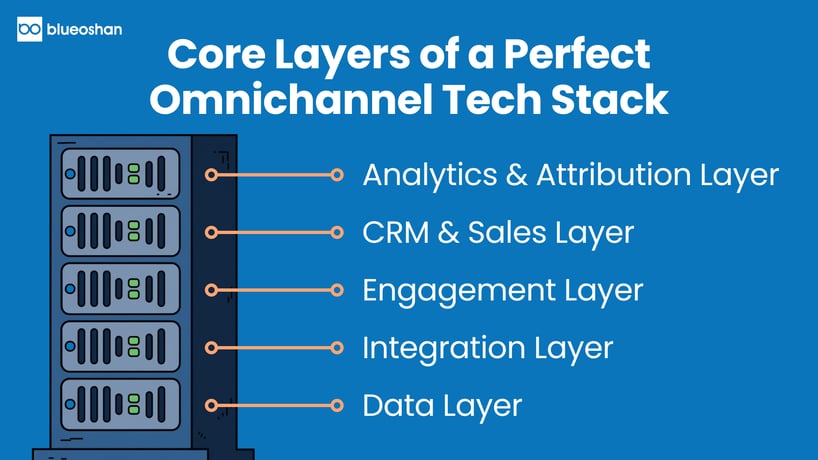
1. Data Layer (CDP / Data Warehouse)
The data layer is the foundation of the stack. This is where you perform data unification. This layer ingests, cleans, and consolidates customer data from every possible source.
A Customer Data Platform (CDP) often serves as this central repository. It builds comprehensive customer profiles that update in real time. It links a customer’s website behavior to their purchase history and support interactions.
The data layer must resolve customer identity. You must be able to recognize the same individual whether they browse on their phone, open an email on their laptop, or visit a physical store. Without a unified data layer, you do not have an omnichannel strategy.
2. Integration Layer (APIs / Middleware)
The integration layer is the "glue" that connects your systems. It facilitates the seamless flow of data between the core components.
This layer uses Application Programming Interfaces (APIs) and middleware solutions. These connections ensure that when data changes in one system (like a CDP), it updates in others (like an email platform) without delay. Robust CRM integration happens in this layer. This integration connects your front-office engagement tools to your sales and service systems.
3. Engagement Layer
The engagement layer consists of the tools you use to communicate directly with customers. These systems execute your marketing automation.
This layer includes your email service provider (ESP), SMS marketing platforms, mobile push notification services, and social media tools. A key component here is web and app personalization technology. The engagement layer is the visible part of your omnichannel marketing. It delivers the messages you orchestrate.
4. CRM & Sales Layer
Your Customer Relationship Management (CRM) system is the system of record for direct interactions. It is essential for B2B and high-touch B2C businesses.
Proper CRM integration links your marketing activity to sales outcomes. Your sales team can see how leads interact with marketing campaigns. Marketing can track which leads turn into revenue. This alignment is necessary for true customer journey visibility.
5. Analytics & Attribution Layer
This final layer measures performance. You cannot improve your strategy without marketing analytics.
This layer uses tools for attribution modeling and business intelligence (BI). It connects cost data from your ad platforms to revenue data from your CRM or e-commerce system. Marketing analytics allow you to visualize the complete customer journey and see how each channel contributes to conversion.
How These Layers Enable Omnichannel Marketing
Your stack must operate as an integrated unit. When all layers are connected, you can execute complex strategies effortlessly. Data flows continuously, driving smarter decisions.
Unified data in the CDP allows for highly accurate targeting. Your segmentation is based on actual behavior, not guesses. Better data enables sophisticated marketing automation.
Consider this practical customer journey:
- Discovery: A customer searches on Google. They find and click your paid ad. The analytics layer records the source.
- Engagement: They browse your website and abandon their cart. The engagement layer’s web personalization tool captures this event.
- Personalization: Your CDP (Data Layer) updates the customer's profile instantly.
- Action: The integration layer triggers an automated email. The engagement layer sends a personalized email with a 10% discount for the exact items left in the cart.
- Conversion: The customer opens the email and completes the purchase.
- Follow-up: The CRM (Sales Layer) updates to show a successful purchase. The email platform immediately shifts from "abandoned cart" flow to "post-purchase" flow.
- Analysis: The analytics layer attributes the sale correctly to the combination of the initial search ad and the personalized email.

Key Capabilities Required for Omnichannel Marketing
Your tech stack is useless if it does not offer specific capabilities. Successful omnichannel marketing demands that your technology perform several critical functions.
- Real-time Data Synchronization: Data must update everywhere, immediately. If a customer changes their preferences on your website, your email system must reflect that choice seconds later. Delayed data leads to broken experiences.
- Customer Identity Resolution: Your stack must create a single, unified view of each customer. It uses identifiers like email, phone number, and cookie data to match behaviors across devices and channels. You cannot market effectively if you think one customer is three different people.
- Cross-Channel Orchestration: You need the ability to build and manage customer journeys that span multiple platforms. A single tool should coordinate when an email goes out, when a push notification triggers, and which segment gets a specific ad on Facebook.
- Personalization at Scale: Effective personalization requires dynamic data. Your engagement tools must use the unified profiles from your CDP to deliver messaging based on behavior, location, and purchase history, automatically and at any scale.
- Closed-Loop Reporting: Your analytics must tie every marketing activity to its outcome. You must know what percentage of revenue was influenced by your marketing automation versus your social media ads. Closed-loop reporting provides true ROI

Building vs. Buying: How to Approach Your Stack
You must decide how to assemble your stack. The choice is often between a "best-of-breed" composable stack or an "all-in-one" platform.
A composable stack involves buying individual tools (best-of-breed CDP, ESP, CRM) and integrating them yourself. This approach offers extreme flexibility and scalability. It is often the best choice for complex organizations. It prevents vendor lock-in and allows you to use the absolute best tool for each function. The downside is it requires strong technical resources for integration.
An all-in-one platform provides a single suite with multiple modules (email, web, CRM, analytics) already integrated. This approach offers a faster time to market and a lower initial technical burden. However, these suites can be rigid. The integration between modules is often not as deep as it appears. Individual features (like the social tool) may not be as robust as best-of-breed alternatives.
The choice depends on your budget, team capabilities, and business requirements. For scalable omnichannel marketing, a composable stack using robust APIs and a central CDP is often the superior long-term strategy.
Common Mistakes to Avoid in Omnichannel Marketing
Be aware of common pitfalls. Many companies make these mistakes when building their technical infrastructure.
- Adding Too Many Tools Too Quickly: Do not get distracted by new features. Add technology only when it solves a specific, identified problem in your customer journey. Excess tools increase complexity.
- Ignoring Data Quality: Your technology is only as good as your data. Prioritize data cleansing and governance before purchasing advanced automation or personalization tools. "Garbage in, garbage out" applies here.
- Not Aligning Marketing and Sales Systems: Marketing and sales teams must share the same data view. If your marketing tools do not have a robust CRM integration, your lead handoff will fail and you will lose revenue opportunities.
- Focusing on Channels Instead of Customer Journeys: Do not manage channels. Manage journeys. Your technology stack should enable you to build experiences around the customer's needs, not the platform's constraints.
Conclusion
An effective omnichannel tech stack is an integrated ecosystem. It eliminates fragmentation. Successful omnichannel marketing is impossible without data unification and seamless system integration. If your systems are disconnected, your customer experience will be too. Focus on building the data layer first. Ensure your integrations are robust. When your technology is unified, your marketing can be too. BlueOshan provides the critical omnichannel orchestration you need. We help you unify your data, orchestrate complex customer journeys across every channel, and enable truly scalable omnichannel marketing. Is your current martech stack holding you back? Book an Omnichannel Stack Audit with BlueOshan today. Our experts will review your current tools, identify data silos, and provide a roadmap to build a high-performing ecosystem.

 Previous Post


Share this post!


Related Articles