-
MarTech Services

-
Solutions
Omnichannel Orchestration
Make sense of your data. Data meets innovation to create unparalleled customer experiences and drive your business forward.
Email Deliverability
Email campaigns with unmatched inbox placement, real-time insights, and expert support with our Email Deliverability solutions.
Organic Search Amplification
Organic Search Amplification puts your brand into Google and Bing autocomplete - turning that generic search into a branded one
-
Website Services
Website Development
We bring together expertise, creativity, and measurable results, making us the go-to choice for HubSpot website creation.
Website Migration
Our approach to website migration goes beyond a technical transfer; we prioritize a user-centric experience.
Website Maintenance
Optimize your online presence with effective, growth-driven websites focusing on nurturing website visitors, creating and deploying content, and tracking progress with precision.
Website Audit
Is your website performing at its peak? Our CMS Consultants are here to help you find out with our comprehensive Website Audit service.
- Case Studies
- Blog
-
Company
Clients
We have worked with clients from various industries across the globe, making our journey diverse and exciting.
Team
We put decades of experience where our mouth is. So what you get is market-tested and tried, not theory. We believe in plain speak, which we believe works better than jargon.
Solutions Partner
BlueOshan is not just a partner; we are among the most experienced and adept in the HubSpot ecosystem.
- Contact Us


Asphia Khan
May 6, 2026

If you've ever tried to use a general-purpose automation tool to manage a marketing campaign, you already know the frustration. You spend more time configuring the tool than you save using it. And when something breaks, a field mapping is wrong, a webhook doesn't fire, a list doesn't sync; you're the one debugging it.
Generic automation tools are built to work for everyone. That's also why they often work perfectly for no one.
MarTech-native AI builds are different. They're built specifically for how marketing and sales teams operate. This post breaks down exactly what that difference looks like in practice.
What "Generic Automation" Actually Means
Generic automation tools, such as Zapier, Make, or a basic RPA setup, work by connecting apps and triggering actions based on rules you define. They're flexible and broad. You can use them to automate anything from invoice approvals to birthday emails.
That flexibility is the product. But it's also a limitation.
These tools have no understanding of what a campaign is, what a lead qualification process looks like, or why a WhatsApp message needs to be sent in a specific sequence tied to a delivery status. You have to teach them all of that, step by step, every time.
What MarTech-Native Means
A MarTech-native AI build is designed from the ground up with sales and marketing operations as the context. It already understands:
- How campaign data is structured
- What a CRM record looks like and how it changes across a sales cycle
- The difference between a bounce, a block, and an unsubscribe and what to do with each
- How multi-channel execution works across email, SMS, WhatsApp, and RCS
- What "audience segmentation" and "template matching" actually require at the data level
You don't start from scratch. The domain knowledge is already built in.
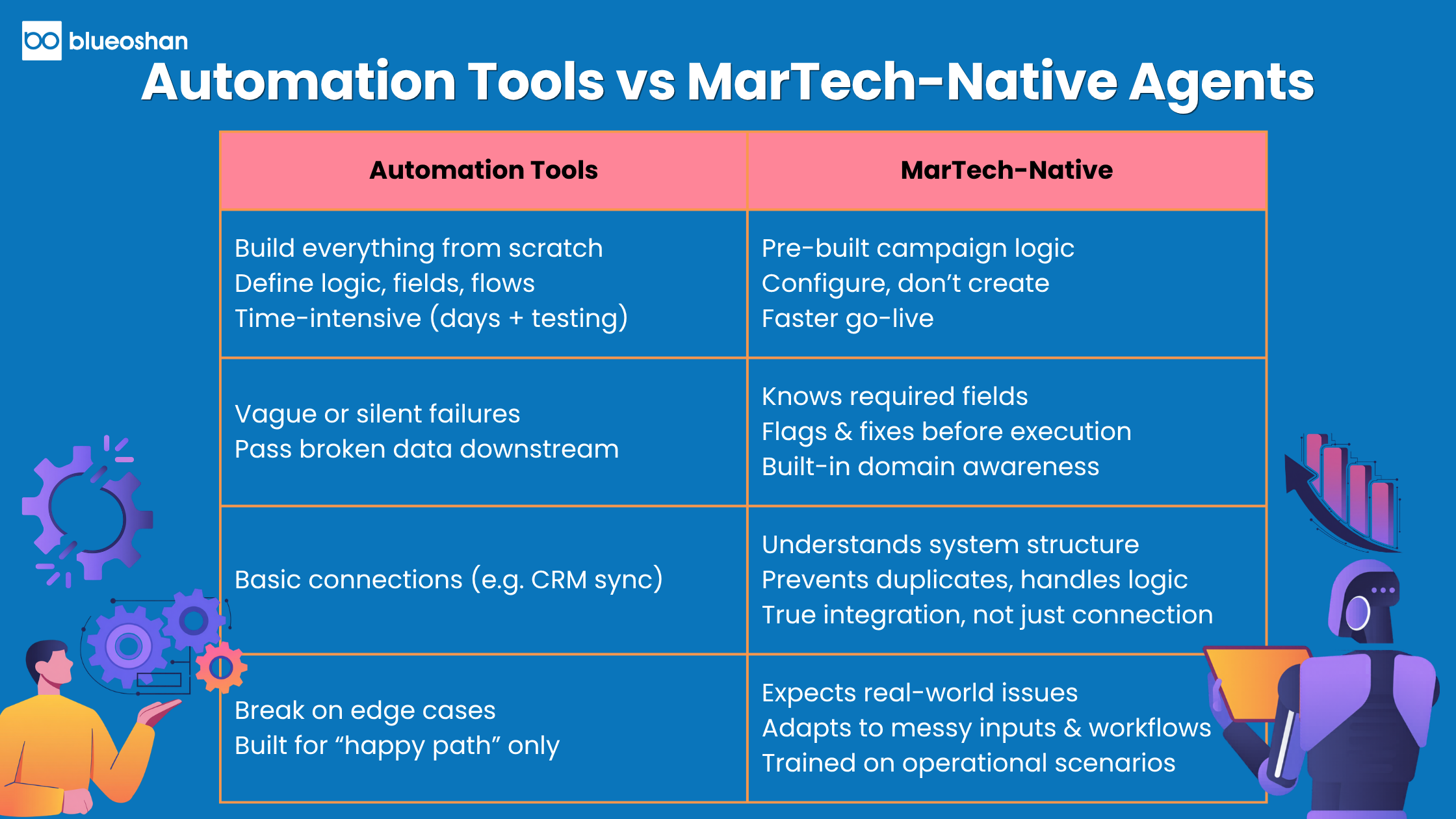
The Real Differences, Side by Side
1. Setup time
With a generic tool, you configure everything. You define the fields, the logic, the conditions, and the error handling. For a campaign intake workflow, that could take days of work and several rounds of testing.
With a MarTech-native agent, the core logic for campaign intake, parsing the request, validating data, checking for missing fields, and routing to the right team is already understood. You're configuring your specific setup, not building the concept from zero.
2. Error handling
Generic tools fail silently or throw vague errors. They don't know that a missing "segment ID" means the campaign can't be launched. They just pass a null value downstream and let the next system deal with it.
A MarTech-native agent knows what fields are required for a campaign to be valid. It checks, flags, and asks for the missing information before anything moves forward. That's not a rule someone programmed in. That's domain awareness.
3. Integration depth
Generic tools connect to HubSpot. MarTech-native builds understand HubSpot, the difference between a contact, a company, and a deal, how lifecycle stages work, what triggers a workflow, and how to write back data without creating duplicates.
Connecting is not the same as integrating. A native build does the latter.
4. Handling exceptions
In marketing operations, exceptions are not rare. A campaign gets paused mid-send. A contact list has duplicates. A delivery report comes back with a format that doesn't match the expected schema. An agency sends a brief over WhatsApp instead of the intake form.
Generic tools break here. They handle the happy path. MarTech-native agents are built expecting these situations. They're trained on real operational data, so they know what to do when things don't go as planned.
5. Time to value
A generic automation tool requires your team to become experts in the tool itself before they can automate anything. There's a learning curve, a build phase, and usually a "we're redoing this because it broke in production" phase.
MarTech-native agents deploy faster because the domain work is already done. A simple agent, such as an email intake and routing agent, can go live in hours, not weeks.
Where Generic Tools Still Make Sense
This isn't a case against all general-purpose tools. For simple, one-off connections syncing a form response to a spreadsheet, sending a Slack notification when a deal closes, generic automation works fine.
The problem starts when you try to use these tools for complex, multi-step marketing operations. They weren't designed for it, and you'll feel that at every stage.
What This Means for Your Team
If your marketing or sales ops team is spending significant time managing automation, fixing broken workflows, or manually handling exceptions that "the tool should have caught", that's a sign the tool doesn't understand your domain.
The right AI build doesn't just automate tasks. It understands the context in which those tasks exist. That's what makes it actually useful at scale.

 Previous Post


Share this post!


Related Articles