-
MarTech Services

-
Solutions
Omnichannel Orchestration
Make sense of your data. Data meets innovation to create unparalleled customer experiences and drive your business forward.
Email Deliverability
Email campaigns with unmatched inbox placement, real-time insights, and expert support with our Email Deliverability solutions.
Organic Search Amplification
Organic Search Amplification puts your brand into Google and Bing autocomplete - turning that generic search into a branded one
-
Website Services
Website Development
We bring together expertise, creativity, and measurable results, making us the go-to choice for HubSpot website creation.
Website Migration
Our approach to website migration goes beyond a technical transfer; we prioritize a user-centric experience.
Website Maintenance
Optimize your online presence with effective, growth-driven websites focusing on nurturing website visitors, creating and deploying content, and tracking progress with precision.
Website Audit
Is your website performing at its peak? Our CMS Consultants are here to help you find out with our comprehensive Website Audit service.
- Case Studies
- Blog
-
Company
Clients
We have worked with clients from various industries across the globe, making our journey diverse and exciting.
Team
We put decades of experience where our mouth is. So what you get is market-tested and tried, not theory. We believe in plain speak, which we believe works better than jargon.
Solutions Partner
BlueOshan is not just a partner; we are among the most experienced and adept in the HubSpot ecosystem.
- Contact Us


Christina Rachel Rajiv
July 31, 2026

A potential customer clicks a paid advertisement, reads a blog post, downloads a guide, speaks with a sales representative, and later contacts customer support.
To the customer, these interactions are part of one relationship with your company. Inside many businesses, however, each interaction is stored in a different system.
Marketing sees campaign engagement. Sales sees deals and conversations. Customer service sees tickets and product issues. When these systems do not communicate, teams make decisions using incomplete information.
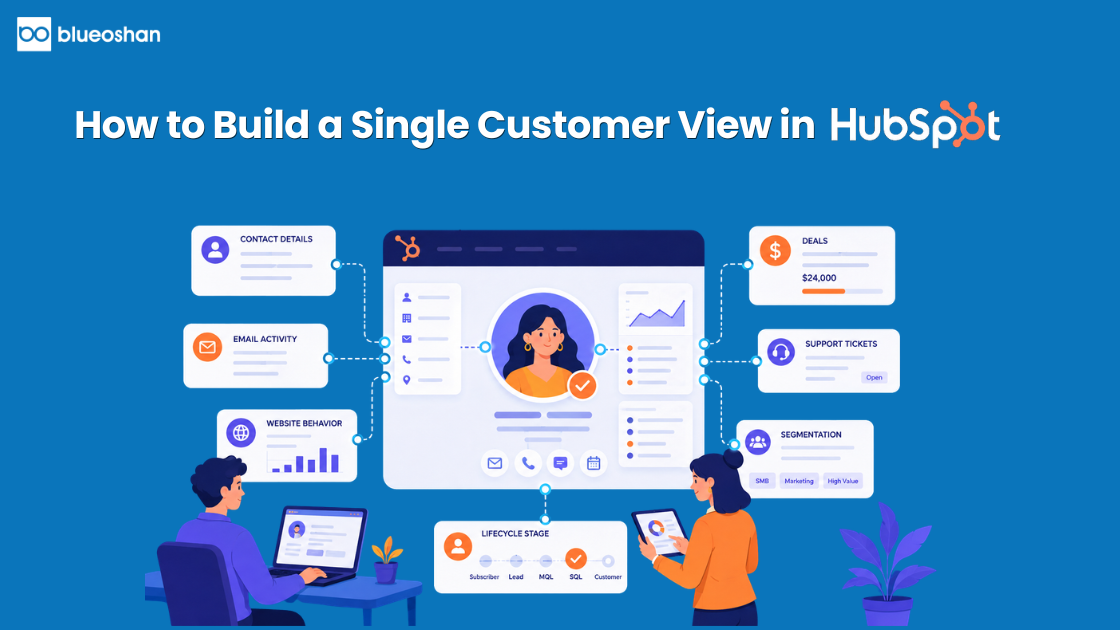
CRM integration solves this problem by bringing marketing, sales, and customer service data into one connected environment. For B2B SaaS companies using HubSpot, this creates a shared customer record that can support marketing automation, sales pipeline management, service delivery, business intelligence, and omnichannel engagement.
The objective is not simply to move data between applications. It is to turn fragmented customer information into coordinated action.
Why Disconnected Customer Data Creates Revenue Problems
Data silos are not merely an IT inconvenience. They affect the entire customer journey.
Marketing cannot see what produces revenue
A marketing team may know how many leads a campaign generated but not how many became qualified opportunities, paying customers, or long-term accounts. This makes it difficult to distinguish high-value campaigns from campaigns that create activity without meaningful revenue.
Sales receives incomplete lead information
Sales representatives may receive a name and email address without knowing which advertisements the prospect clicked, which pages they visited, which content they downloaded, or which product features interested them.
Without this context, sales conversations begin with unnecessary discovery rather than relevant insight.
Customer service lacks commercial context
A service agent may see a ticket but not the customer’s plan, contract value, implementation history, previous sales promises, or renewal status. This can result in generic responses at moments when the account requires more thoughtful attention.
Customers receive inconsistent communication
Disconnected systems can cause businesses to:
- Send acquisition offers to existing customers
- Continue lead-nurturing emails after a deal closes
- Promote products a customer already purchased
- Ask customers to repeat information they previously provided
- Send marketing messages during an unresolved support escalation
CRM integration reduces these inconsistencies by giving teams access to the same underlying customer data.
The Connected Customer Data Model
A successful CRM integration begins with a shared data model. Each team may use different tools, but they should agree on the meaning of key records, fields, stages, and events.
A connected model typically includes four categories of information.
1. Identity and account data
This includes names, email addresses, phone numbers, companies, job titles, account relationships, regions, industries, and communication preferences.
Identity resolution is essential because the same person may appear in several platforms under slightly different details. Without reliable matching and deduplication, teams may create duplicate contacts, inaccurate reports, and conflicting communications.
2. Engagement data
Engagement data shows how prospects and customers interact with the company. It may include:
- Website visits
- Form submissions
- Email engagement
- Webinar attendance
- Advertisement interactions
- Content downloads
- Meetings
- Calls
- Chat conversations
- In-app activity
Marketing can use these signals for segmentation and automation, while sales can use them to prioritize outreach.
3. Revenue data
Revenue data includes lifecycle stages, lead status, deal value, pipeline stage, products of interest, quotations, contract dates, subscription value, renewal probability, and closed revenue.
Connecting this information to marketing engagement makes it possible to assess campaign influence beyond lead volume.
4. Service and customer-success data
Service data may include onboarding status, support tickets, response times, issue categories, customer satisfaction, product adoption, health scores, escalations, and renewal risk.
When this information is available across teams, a support issue can influence account management, sales outreach, and marketing communication.
How Marketing, Sales, and Service Data Work Together
CRM integration becomes valuable when data triggers coordinated processes rather than simply appearing in a database.
Marketing: From broad campaigns to relevant automation
Marketing automation performs best when it uses current CRM data.
Instead of sending the same campaign to every contact, marketers can build segments using attributes such as lifecycle stage, industry, account type, buying intent, product interest, engagement history, or customer status.
A connected system can automatically:
- Enroll new prospects in an appropriate nurture sequence
- Remove sales-qualified leads from general campaigns
- Suppress existing customers from acquisition advertising
- Re-engage accounts that show renewed interest
- Promote relevant add-ons to eligible customers
- Pause promotional messages during sensitive service issues
This makes automation responsive to the customer’s actual relationship with the business.
Sales: A more informed and manageable pipeline
Sales pipeline management depends on complete, reliable information.
When marketing and CRM data are synchronized, sales teams can see how a lead entered the database, which campaigns influenced the account, what content the buyer consumed, and what actions preceded the sales conversation.
Integration can also automate operational tasks such as:
- Assigning leads by geography, company size, product, or account ownership
- Creating follow-up tasks
- Updating lead and deal stages
- Recording meetings and communication
- Alerting representatives when target accounts revisit high-intent pages
- Returning unready leads to marketing nurture programs
- Creating onboarding handoffs after a deal closes
BlueOshan, for example, provides HubSpot systems integration services designed to connect CRM and sales operations with tools such as Salesforce, Slack, Gmail, email platforms, and content management systems. Its broader HubSpot services cover the Marketing, Sales, Service, and Content hubs. (blueoshan.com)
The purpose of these connections is not to automate every interaction. It is to remove manual administration and give salespeople better information for human conversations.
Customer service: From ticket handling to relationship management
Customer service software often contains some of the most valuable customer intelligence in the organization.
Support interactions reveal recurring product problems, implementation barriers, unmet expectations, training needs, customer sentiment, and expansion opportunities. When service data remains isolated, these insights rarely influence other teams.
A connected CRM can allow businesses to:
- Give agents a complete account history
- Route tickets based on customer segment or issue type
- Notify account owners about high-priority cases
- Create follow-up workflows after ticket resolution
- Identify customers with repeated issues
- Exclude dissatisfied customers from inappropriate campaigns
- Trigger customer-success outreach when adoption declines
- Share common support themes with product and marketing teams
Service data should therefore be treated as a source of business intelligence, not just an operational record.
Moving from CRM Integration to Omnichannel Marketing
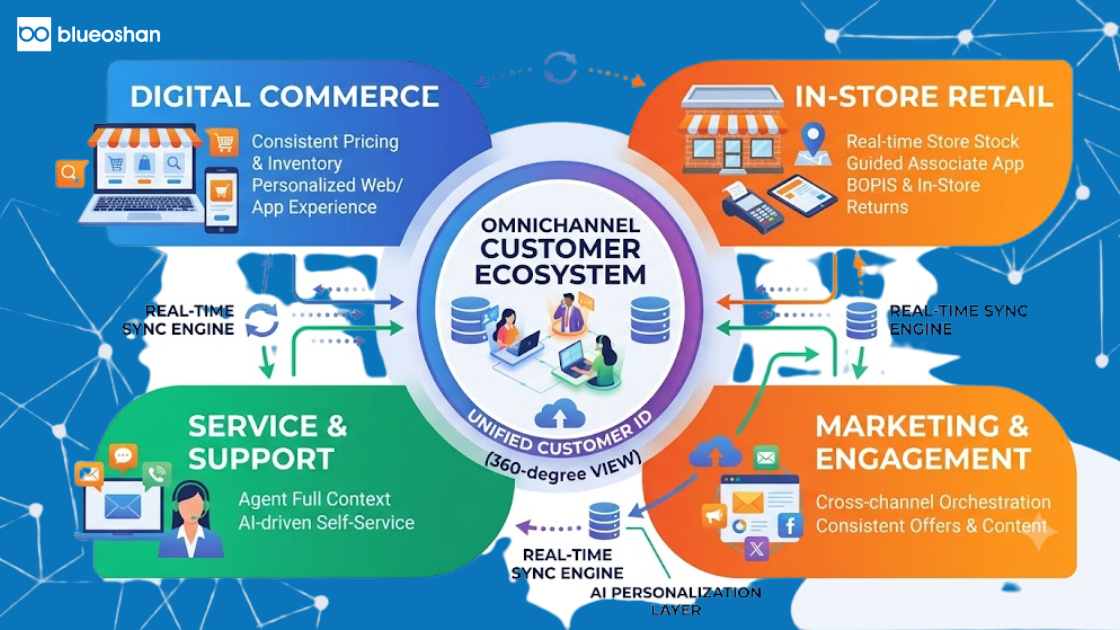
CRM integration establishes the data foundation. Omnichannel marketing uses that foundation to coordinate the customer experience across channels.
A multichannel company may use email, paid media, social media, websites, messaging, sales outreach, and support. An omnichannel company connects the data and decision-making behind those channels.
That distinction matters. Adding more channels without connecting them often creates more fragmentation.
BlueOshan describes its omnichannel marketing orchestration and data management offering as a way to integrate information from sources such as digital advertising channels and social media platforms into a unified environment. The service focuses on converting cross-channel data into actionable intelligence and creating a clearer view of customer interactions. (blueoshan.com)
In practical terms, this can help a business coordinate experiences such as the following:
- A prospect engages with a LinkedIn or Google advertisement.
- The interaction is associated with a CRM contact or account.
- The prospect visits a product page and downloads a resource.
- HubSpot updates the contact’s interests and engagement score.
- Marketing automation sends content related to the prospect’s use case.
- A high-intent action creates a sales notification.
- Sales can review the prospect’s journey before making contact.
- After conversion, acquisition campaigns are suppressed.
- Onboarding and service workflows begin.
- Future communications respond to product usage, support activity, and account status.
The result is a journey shaped by shared customer context rather than a series of disconnected campaigns.
Where BlueOshan’s Omnichannel Services Fit
Technology alone does not create an omnichannel operation. Businesses need to decide which data to collect, how to structure it, where it should be stored, and what actions it should trigger.
BlueOshan positions itself as a MarTech services company and HubSpot Solutions Partner helping businesses connect marketing, sales, and service operations. Its services include omnichannel marketing orchestration, HubSpot onboarding, migration, administration, systems integration, and website and e-commerce development. (blueoshan.com)
Within a CRM integration initiative, its omnichannel capabilities can contribute in several areas.
Data-source integration
Customer information may be distributed across HubSpot, advertising platforms, social channels, sales tools, service applications, websites, e-commerce platforms, and internal databases.
The first requirement is to identify which sources should connect to the CRM or supporting data environment and how frequently information should synchronize.
Marketing data lifecycle management
Data must be collected, standardized, enriched, activated, measured, and maintained. A strong process includes naming conventions, field definitions, identity rules, consent handling, deduplication, access controls, and retention policies.
This prevents an integration from becoming a faster way to distribute poor-quality data.
Cross-channel journey orchestration
Once data is unified, teams can define how customer actions should affect communication across channels.
For example, an account that enters an active opportunity stage may be removed from broad lead-generation advertising and placed into a more focused journey that supports the sales process.
BlueOshan’s omnichannel approach emphasizes unified data and coordinated customer journeys rather than operating every channel independently. (blueoshan.com)
HubSpot implementation and optimization
HubSpot can serve as the operational center for contact, company, deal, ticket, campaign, and engagement data. However, portals frequently require custom properties, lifecycle definitions, pipelines, workflows, permissions, integrations, and reports that reflect the organization’s real processes.
A partner can help translate business requirements into a maintainable HubSpot architecture rather than merely installing software.
Reporting and attribution
A unified environment allows marketers and revenue leaders to analyze relationships among campaigns, engagement, pipeline, revenue, retention, and service outcomes.
The goal is not a single dashboard containing every available metric. It is a reporting structure that answers questions such as:
- Which campaigns create qualified pipeline?
- Which channels influence high-value opportunities?
- Where do leads stall?
- Which customer segments require the most support?
- How does product adoption affect renewal?
- Which service issues are associated with churn?
- Which journeys produce expansion revenue?
A Practical CRM Integration Roadmap
CRM integration should be implemented as a business transformation initiative, not an isolated software project.
Step 1: Map the complete customer journey
Document how someone moves from anonymous visitor to lead, opportunity, customer, active user, renewal, and advocate.
Identify every major interaction and the system that currently records it. This exposes gaps, duplicated processes, and points where customers lose continuity.
Step 2: Define the CRM system of record
Decide which platform owns each type of information.
For example, HubSpot may be the system of record for contact identity, lifecycle stage, campaign engagement, deals, and tickets, while a subscription platform owns billing data and a product platform owns usage events.
Not every field needs to exist everywhere. Clear ownership prevents conflicting updates.
Step 3: Standardize fields and lifecycle stages
Marketing, sales, and service teams must use consistent definitions.
Terms such as “lead,” “qualified lead,” “opportunity,” “customer,” “active account,” and “at-risk account” should have agreed criteria. Otherwise, synchronized systems will still produce inconsistent reporting.
Step 4: Prioritize high-value integrations
Do not connect every application simultaneously.
Begin with integrations that support the most important customer or revenue processes, such as:
- Website and HubSpot CRM
- Marketing automation and sales pipeline
- CRM and customer service software
- CRM and subscription or billing data
- Advertising platforms and conversion data
- CRM and business intelligence tools
A phased approach reduces risk and allows teams to validate results.
Step 5: Establish data synchronization rules
For every connection, define:
- Which records synchronize
- Which fields are included
- Whether synchronization is one-way or two-way
- Which system wins during a conflict
- How frequently updates occur
- How deleted or merged records are handled
- What happens when an integration fails
These rules are essential for dependable data synchronization.
Step 6: Build automation around business moments
Focus on moments where speed, relevance, or consistency matters.
Useful examples include lead routing, qualification, deal-stage updates, sales alerts, onboarding, ticket escalation, renewal preparation, customer re-engagement, and churn-risk intervention.
Step 7: Create shared reporting
Develop dashboards that show the relationship between marketing activity, sales pipeline, revenue, service performance, and retention.
Each metric should have an owner and an agreed definition.
Step 8: Monitor and improve data quality
CRM integration is not a one-time implementation.
New tools, fields, campaigns, products, and business processes will affect the data model. Schedule regular audits for duplicates, missing values, sync errors, outdated workflows, unused fields, and inconsistent lifecycle stages.

Common CRM Integration Mistakes
Integrating tools without redesigning the process
Connecting two systems will not fix unclear responsibilities or poorly defined handoffs. Automating a broken process usually makes the problem occur faster.
Synchronizing every available field
More data is not always better. Excessive synchronization creates clutter, increases conflict risk, and makes governance harder.
Only synchronize information that has a clear operational, analytical, or customer-experience purpose.
Ignoring customer consent
Omnichannel engagement must respect subscription preferences, lawful processing requirements, channel permissions, and communication frequency.
Consent data should be included in the integration design from the beginning.
Building automation without exception handling
Not every customer journey follows the expected path. Workflows should account for missing data, duplicate records, reopened opportunities, escalated tickets, manual overrides, and integration failures.
Treating service data as an afterthought
Many CRM projects connect marketing and sales first but leave customer service isolated. This prevents the organisation from creating a genuinely unified customer experience.
What Success Looks Like
A successful CRM integration gives every team a relevant view of the same customer relationship.
Marketing can connect campaigns to pipeline and revenue. Sales can understand buyer intent and previous engagement. Customer service can respond with full account context. Leaders can make decisions using consistent business intelligence.
Most importantly, customers experience fewer organisational boundaries.
They receive communication that reflects what they have already done, what they currently need, and where they are in the relationship.
That is the real value of CRM integration: not simply synchronised records, but synchronized teams and customer journeys.
Build an Actionable Customer Data Foundation
Connecting marketing, sales, and customer service data requires more than choosing an integration application. It requires a clear customer data model, disciplined governance, thoughtful automation, and an omnichannel strategy.
For HubSpot users, BlueOshan brings these elements together through systems integration, HubSpot professional services, and omnichannel marketing orchestration. Its approach can help businesses unify customer data, coordinate engagement across touchpoints, and build reporting that connects marketing activity with sales and service outcomes. (blueoshan.com)
When customer data becomes connected and actionable, CRM stops functioning as a passive database. It becomes the operating system for the entire customer relationship.
 Previous Post


Share this post!


Related Articles