-
MarTech Services

-
Solutions
Omnichannel Orchestration
Make sense of your data. Data meets innovation to create unparalleled customer experiences and drive your business forward.
Email Deliverability
Email campaigns with unmatched inbox placement, real-time insights, and expert support with our Email Deliverability solutions.
Organic Search Amplification
Organic Search Amplification puts your brand into Google and Bing autocomplete - turning that generic search into a branded one
-
Website Services
Website Development
We bring together expertise, creativity, and measurable results, making us the go-to choice for HubSpot website creation.
Website Migration
Our approach to website migration goes beyond a technical transfer; we prioritize a user-centric experience.
Website Maintenance
Optimize your online presence with effective, growth-driven websites focusing on nurturing website visitors, creating and deploying content, and tracking progress with precision.
Website Audit
Is your website performing at its peak? Our CMS Consultants are here to help you find out with our comprehensive Website Audit service.
- Case Studies
- Blog
-
Company
Clients
We have worked with clients from various industries across the globe, making our journey diverse and exciting.
Team
We put decades of experience where our mouth is. So what you get is market-tested and tried, not theory. We believe in plain speak, which we believe works better than jargon.
Solutions Partner
BlueOshan is not just a partner; we are among the most experienced and adept in the HubSpot ecosystem.
- Contact Us


Srisha A S
December 22, 2025

Think about how you shop today.
You might see a product on Instagram, check reviews on Google, visit the brand’s website, talk to customer support on WhatsApp, and finally buy it from their app or store. That entire journey, your clicks, your questions, your interests creates data.
For brands, this is both a huge opportunity and a huge challenge.
If they can connect all this information and understand you better, they can send the right messages at the right time, offer helpful reminders, and give you a smooth experience across all channels. If they can’t connect this information, everything becomes messy with wrong messages, repeated emails, irrelevant ads, and confused customers.
This is exactly why Marketing Data Lifecycle Management is now essential for brands that want to succeed in omnichannel marketing.
Let’s break this down in the simplest way possible.
What Is Marketing Data Lifecycle Management ?
Imagine the customer data in your business as water flowing through pipes.
If the pipes are blocked, dirty, or disconnected, the flow stops and everything gets messy.
Marketing Data Lifecycle Management makes sure that:
- Data comes in properly
- It stays clean and organised
- It flows smoothly between systems
- It reaches the right places
- It helps brands make smarter decisions
Now imagine combining this with omnichannel marketing, a strategy where all customer touchpoints work together like one connected machine. For this machine to run smoothly, the data must also flow smoothly.
That’s where Marketing Data Lifecycle Management services come in.

So, Which Services Support Omnichannel Marketing?
Here are the key types of Marketing Data Lifecycle Management services that make omnichannel experiences possible which is explained in a way anyone can understand.
1. Customer Data Integration Services
(Connecting all your customer touchpoints)
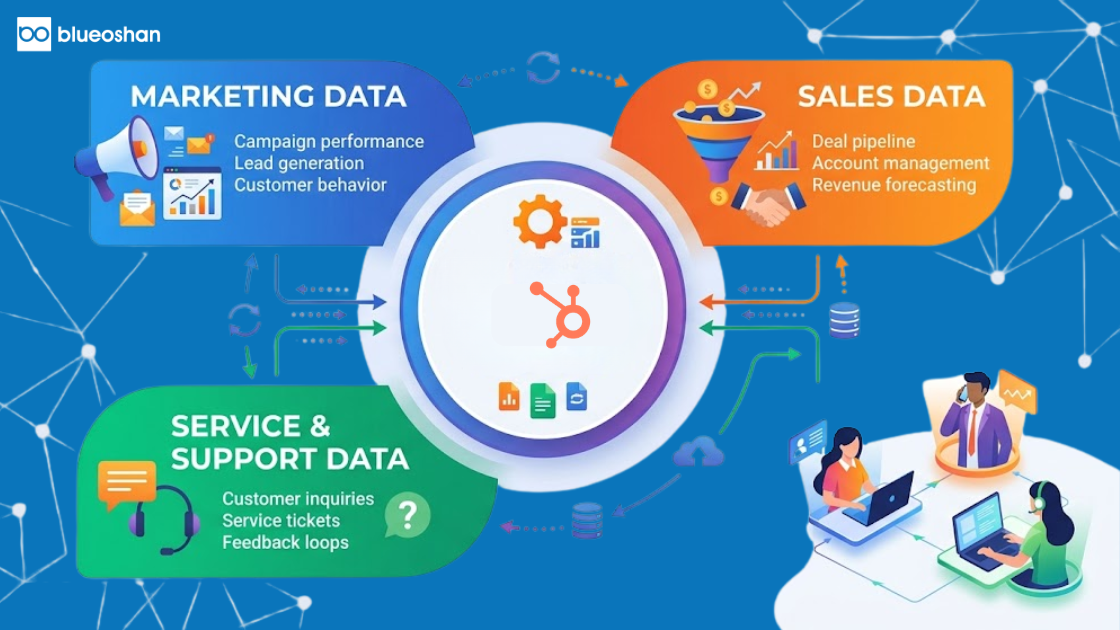
Modern customers interact with a brand through many channels such as websites, stores, apps, emails, ads, WhatsApp, marketplaces, and more. Each interaction creates a little piece of data.
Integration services pull all this scattered data into one place, usually your CRM (Customer Relationship Management) system.
Why this matters for omnichannel:
Without this connection, your systems won’t “talk” to each other.
That’s why sometimes you get:
- An email saying “complete your purchase” even after you already bought the product
- Ads for something you just purchased
- Duplicate messages on SMS and WhatsApp
Integration fixes all of this by keeping everything in sync.
2. Identity Resolution and Data Cleaning Services:
(Making sure each customer has only ONE profile)
Here’s a common problem, one customer, multiple records:
- One with their phone number
- One with their email
- One with a typo in their name
- One from a marketplace
This confuses your system and leads to mistakes in marketing.
Identity resolution tools merge all these records into one clean profile, making sure every customer has a complete and accurate history.
Why this matters for omnichannel:
It avoids:
- Duplicate messages
- Wrong recommendations
- Missed follow-ups
It ensures your brand looks organised and not annoying.
- Building a Unified Customer Profile
(Seeing your customer clearly in one place)
Once the data is clean and connected, the next step is to create a single customer profile with details like:
- What they like browsing
- How often they buy
- Which channels they prefer
- Their past conversations
- Their loyalty or rewards activity
Why this matters:
With this, brands can send messages that actually make sense to the customer.
For example:
- If you browse shoes, the brand sends shoe recommendations and not random products.
- If you prefer WhatsApp over email, reminders come on WhatsApp.
- If you haven’t visited in months, they send you a tailored comeback offer.
This is the heart of omnichannel personalization.
4. Smart Segmentation and Behavioral Insights
(Grouping customers based on what they do, not just who they are)
Older marketing tools grouped people by simple details like age or location.
But omnichannel marketing needs smarter grouping based on behaviour, such as:
- People who browse but don’t buy
- Customers who buy monthly
- Loyal customers who love offers
- Customers who might churn
Why this is important:
It helps brands talk to different customers in different ways, making communication relevant and timely.
For example:
- A “window shopper” gets a reminder
- A “loyal buyer” gets early access
- A “silent customer” gets a reactivation offer
5. Automation and Journey Orchestration Services
(Sending the right message at the right moment)
Once the data and segments are ready, automation tools help brands create customer journeys.
These journeys work across multiple channels at once in email, WhatsApp, SMS, app notifications, and ads.
Examples:
- A WhatsApp nudge after an abandoned cart
- An email series after a purchase
- Targeted ads for people browsing a category
- A replenishment reminder when a product may be running out
These journeys run automatically, provided your data is accurate.
Why this supports omnichannel:
It ensures every customer gets a smooth, connected experience and not random messages.
6. Analytics and Attribution Services
(Helping brands understand what’s working and what’s not)
Brands need to know:
- Which channels customers use before buying
- Which messages lead to conversions
- How customers behave across their journey
- Which marketing spends give the best returns
Attribution services connect all these dots.
Why omnichannel needs this:
If you don’t know what’s working, you can’t improve your marketing.
Analytics helps brands spend wisely, not widely.
7. Data Governance and Privacy Services
(Keeping customer data safe and compliant)
With so much customer information flowing across systems, brands must follow privacy laws and protect customer data.
Governance services ensure:
- Data is stored safely
- Access is controlled
- Customer permissions are respected
- Systems follow compliance rules (like GDPR, DPDP, etc.)
How BlueOshan Helps Brands Build These Capabilities
At BlueOshan, we’ve seen that most brands don’t fail because of creativity but they fail because of disconnected, messy data.
We help brands:
- Connect all customer touchpoints
- Clean and unify their data
- Build strong CRM foundations
- Create smart omnichannel journeys
- Maintain ongoing data health
- Give leaders a single dashboard to see the whole picture
In simple terms, we make your data work harder, so your marketing team doesn’t have to.
Omnichannel Works Only When Your Data Works
Omnichannel marketing is not just sending messages on many channels. It is about giving customers a smooth, connected experience that feels effortless.
This is only possible when a brand uses the right Marketing Data Lifecycle Management services, such as:
- Customer data integration
- Identity resolution
- Unified customer profiles
- Smart segmentation
- Automated journeys
- Analytics and attribution
- Data governance
When your data is clean, connected, and continuously updated, your marketing becomes smarter, your customer experience becomes stronger, and your business grows faster.
 Previous Post


Share this post!


Related Articles